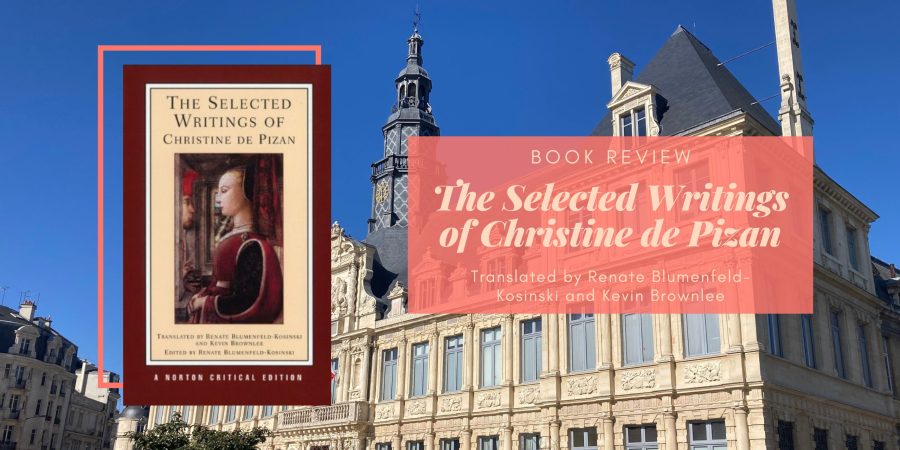
After hearing about Christine de Pizan multiple times (including from the Weird Medieval Guys), I finally decided to borrow a book of her writings. The Selected Writings of Christine de Pizan translates and condenses texts from:
- One Hundred Ballads and Other Ballads
- The God of Love’s Letter
- The Letter from Othea
- The debate on the Romance of the Rose
- The Book of the The City of Ladies
- The Book of the Three Virtues
- The Tale of Joan of Arc
- and much more.
In addition to these translations, there are also seven essays that evaluate Christine’s work and reputation from various academics. These essays are not all positive, in fact one of the essays is there to present a “cautionary dossier on Christine” to “show that she was not, even by the standards of her own day, a reformer or protofeminist; that she is at best a contradictory figure, admirable in some respects, deplorable in others.”
To me, as a non-academic reader, Christine de Pizan was impressive given that she lived in the late 14th century and made her living as a professional writer after the death of her husband. This is someone who made her living with her talent, and that includes her talent for writing as well as her talent for networking and persuasion. What’s more, when it comes to writing, she covered a whole range of genres – poetry, allegory, biography, history, and political treatises.
For me, the most interesting translation was The Letter from Othea, where she presented a fable in four lines, wrote a “gloss” or explanation for it, and then followed it with an allegory of the soul and spiritual lessons. This mimicked the practice of annotating ancient texts and I thought it was interesting that Christine played with form in this manner to come up with this work!
I also appreciated her defence of women in The Book of the City of Ladies, where she brought up examples of women from times past to show that there was no need to smear all women as bad just by the example of a few, as there are plenty of counter-examples to the critics. I thought it was interesting how she structured this defence in conversation with the Lady Reason, Lady Rectitude, and Lady Justice in an extended building metaphor.
Of course, as this is a selection of writings, we often do not get the full text translated. Instead, Blumenfeld-Kosinski and Brownlee will summarise the parts that do not get translated so that the reader can still have a grasp of the whole text. I suppose it’s because many of the texts can standalone as a book, so if you want to sample Christine’s oeuvre, you need to find a way to condense it.
The only thing I found weird was that some of the poetry was translated as prose. This was especially strange in The Tale of Joan of Arc, which became 61 short paragraphs. I did google and it seems this is the most common translation, but honestly I did not realise this was a poem and was confused by the short paragraphs with breaks between until I read that this was a poem.
Overall, I thought that Christine de Pizan was fascinating and I really enjoyed being able to read so many different texts by her. Since I wasn’t planning any formal study, I found the criticism portion to be less engaging – I enjoyed the essays on the problem of feminism in the fifteenth century and how she dealt with the misogynistic tradition, but others didn’t really catch my attention. If you’re looking for an introduction to Christine de Pizan, I think this book is a good one!
Featured Image: Photo from Canva
I keep meaning to reread some of her work!
Are there any in particular you would recommend? I am interesting in exploring more of her work!
This looks really interesting! Calling her “deplorable” in some respects seems rather strong for a critic, though–even one trying to give a more nuanced take! (To be fair, I don’t know exactly what traits the critic was referring to here. Maybe they are deplorable!) But I do like that the essays cover a range of views.
Yes, I was a bit surprised and I’m not too sure I entirely agree (it seems like she is judging Christine by modern standards) but it was an interesting read!