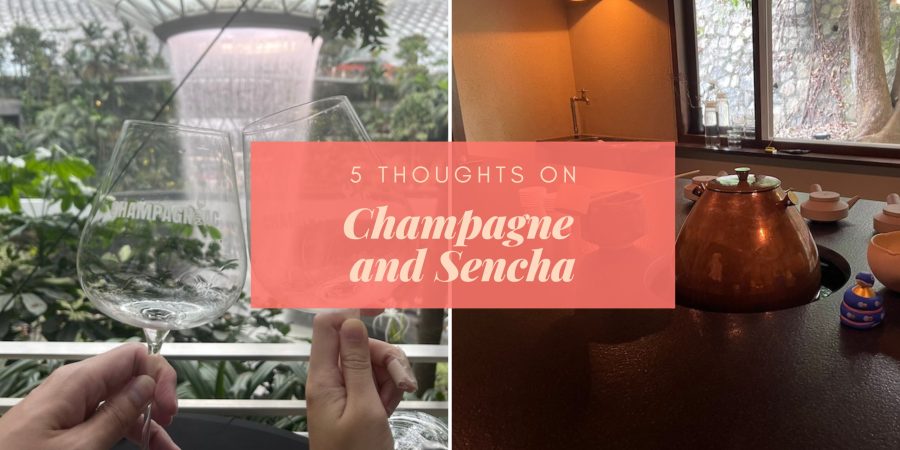
Hello friends! Over the last two weekends, I attended two different events – one for Sayama tea (where I was helping to translate from Japanese to English), and one for champagne. While I am totally new to champagne and don’t know much about it, I thought it might be interesting to just write some of the thoughts that came to mind (blogging slump strategy? maybe!)

- Both champagne and sencha tends to be blended. I thought it was interesting that the lower-priced champagne had more blends, while the more expensive champagnes had fewer blends or more reserve wines. For sencha, I know that it tends to be blended for consistent taste, which is why single origin tea is not very common in Japan.
- Terroir is a big thing for both! At least, for Sayama teas when it comes to sencha – I learnt that due to the northern position of Sayama (it’s one of the northernmost areas where tea is grown in Japan), there are fewer leaves and the leaves tend to be thicker, which is why most sencha from Sayama must be fukamushi or “deep steam”
- Champagne’s region has a lot of microclimates. Having been to St Emilion, I knew there were certain years that were better for wines and was wondering if it was the same for Champagne. What I heard is that because the region has so many microclimates, it’s not easy to give a blanket answer of “oh 20xx was a good year for champagne”
- Tasting both champagne and tea requires practice, but only IF you want. I think for both drinks, it’s fairly easy to try something and know if you like it, and it’s perfectly valid to just buy based on preference. But if you want to know if a champagne is on the dry side, or if it’s sweet, or if there is a mineral note, or if you want to know if this year’s sakura leaf scent in the okuharuka is strong, or if the sencha hits what is classified as good quality, you will have to drink and practice a lot because it’s not always easy to get those notes, even with descriptions in front of you!
- On the note about tasting, I also learnt (and experienced for myself) that the bubbles in champagne could temporarily accelerate intoxication. Meanwhile, if you get tea-drunk, you’ll just have a buzz and be unable to sleep.

Overall, I really enjoyed both events! Champagne is something really new to me, so I appreciated the chance to try a lot of them even though I stopped being able to taste the differences quite so clearly after a while (I did notice, however, that while a lot of people appreciate dryness, I tend to like sweeter glasses!)
Ok, didn’t see the “different events” at first. Thought you attended a tea and champagne blending event. LOL. Eh, tea can also be the non-alcoholic ‘CHAmpagne’… think, sparkling tea. Hehe. But can’t use the name, I think, champagne is GI protected. >_>
Hahaha if only I did that, would be so cool! I tried a sparkling tea from Fortnum and Mason once but it was disappointing… sadly. But yeah, I think tea and wine in general have a lot of similarities wrt to terroir!