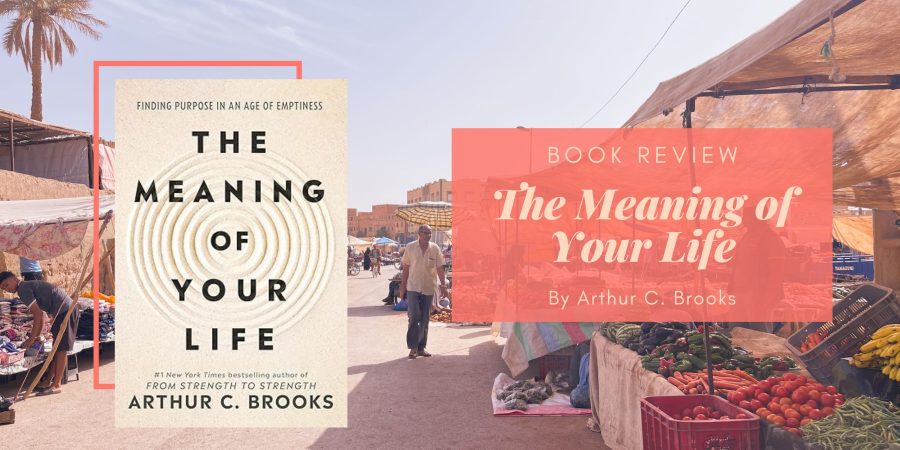
So clearly, there are a few types of books that I will always pick up and read and one of them would be general non-fiction books about life. At this point, I’m not even sure if I’m looking for new ideas, confirmation, or encouragement from these books, but I do find it interesting to read them (especially given all the current events).
The Meaning of Your Life is, simply put, a book about how to develop a sense of meaning to your life. As Arthur Brooks puts it, there are three elements to meaning:
- Coherence:do you think events in your life happen for a reason/is there an overarching narrative to your life
- Purpose: do you have goals/direction?
- Significance: Do you matter to yourself and others?
The problem we have, now, is that there is something that is interrupting our search for meaning. Brooks identifies it as a left brain/right brain problem. Our right brain is the one that asks all the big questions tend to relate back to the meaning of our lives (coherence, purpose, significance), while our left brain thinks about more practical matters (what to eat, where to go, etc). Sometimes, what is going on in our right brains can’t be articulated in words, but meaning does lie there. But in order to get there, we need space for our right brains to work, and the issue is that we have distracted ourselves so successfully that our left brains dominate, leaving us little space to think about the big questions and create opportunities for us to feel meaning in our lives.
With this premise, Brooks guides us through how we can break the digital doom loop, ask the big questions, and then more concretely, take action: to experience love, transcendence, find purpose in work, and to understand the role of beauty and suffering. I would categorise the book into three parts: the first part explains the issue (which other books also tend to do, especially if they are focused on analysing culture/what is wrong), the second part gives the big picture overview of meaning and how we can ask questions, and the third goes through aspects of life that we should be looking at. While the topics gets more and more practical/very close to our every day life as we progress through the book, there are actually guiding questions at the end of every chapter. This means that if you wanted to, you could work your way through each chapter and come up with actionable steps or insights.
I think that the fact that I had over 80 highlights from the book shows how much I like it. To me, this is a pretty practical book and one that I can see myself recommending to people. In a way, you could get all this from reading various books; for example, The Life We’re Looking For focuses on our relationship with tech, while the section on making space for boredom is covered in greater detail with How To Be Bored. But Brooks does a great job of bringing everything together without making it feel superficial, and also citing from a range of examples – from his own religion (Christianity) to what he learnt from the Dalai Lama and other cultures. I definitely would recommend this to anyone who wants to use a book to take a breather and ponder a bit more deeply about their own life.
An interesting book that has clearly raised some great questions for you to ponder on. Hopefully, this helps readers sharpen their thoughts and discover, in due time, the meaning of their lives! 😀
Thank you, yes I hope so too!
I’m impressed at how many books you read about life! If I think about existence too much I get a little wibbly in my head hahaha
Haha I’m not sure why I’m into the topic right now, but I am!