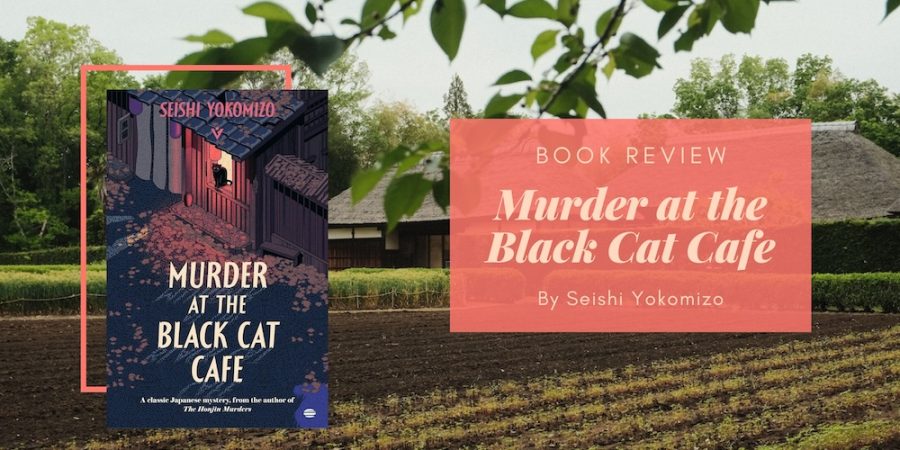
I was browsing Libby one day when I chanced upon Murder at the Black Cat Cafe. The title caught my eye and so I decided to borrow it – realising only later that the author, Seishi Yokomizo, was someone that I had intended to read back when I read The Decagon House Murders.
Murder at the Black Cat Cafe is actually a collection of two Kosuke Kindaichi mysteries, both of which are novella length. The titular Murder at the Black Cat Cafe tells us, through the framing device at the start, that this is a mystery about a faceless corpse, but it will not have the usual resolution (i.e. the presumed victim is actually the killer). With that clue, we start with the body of a woman whose face has been mangled. She is supposed to be the co-owner of the Black Cat Cafe, along with her husband, who has also disappeared.
I won’t give more away, but I thought this was quite a clever story and even without the hint, I didn’t manage to guess the solution. Yet the story felt quite fair, I think someone who is astute might be able to pick up the clues that Yokomizo left in the text.
I also realised that despite the fact that the main detective is supposed to be Kindaichi (whom even I have heard of – although more from the manga and series that was inspired by this Kindaichi), he appears rather late in the story. This works because he is the one who has sent papers and other materials to our author-narrator, and so the story can function without a Watson-esque figure to be the narrator.
The second mystery is another post-WWII story called Why Did The Wheel Creak? As with Murder at Black Cat Cafe, it starts with a framing device that introduces the Honiden family and their complicated history, including two half-brothers (one born into privilege and one born into poverty) who look very similar except for their eyes. I didn’t quite understand the resolution here, because it appeared a bit far fetched, but I found that I really enjoyed the family drama.
Both stories take place after WWII, which turns out to be important context for the stories. In Murder at the Black Cat Cafe, the deceased woman and her husband are both returning from China, and the fact that the cafe exists is also a result of changes in society after the war. And for Why Did the Wheel Creak?, the Honiden family came to prosperity shortly before the war, when Japan was modernising, and the war is a reason why both half-brothers have to leave the village, which in turn sets the scene for the crime. But if you also expected some social commentary in this novel, you’d be disappointed. Perhaps something can be read into the characters, but unlike the Meiji Guillotine Murders, which starts by explicitly talking about the unrest caused by the opening up of Japan to Western ideas, Yokomizo has chosen to make the puzzle of the mystery the star and everything else the backdrop to it.
Overall, I enjoyed this book! It’s a quick read and was a good change of pace after slowly going through a Ukiyo-E dictionary to learn more about the genre. While I wasn’t blown away by both stories, I like them both enough that I want to try a novel-length mystery (perhaps one where Kindaichi plays a more active role) from Yokomizo one day.
I’ve been meaning to pick this one up! It seems like a nice book to read and enjoy
It’s pretty fun! And quite a light read as well!
Cool that you enjoyed this one so much, Eustacia. Hope you’ll try some of the other books as well. This Kindaichi might be different from the one in manga/anime, but it’s definitely a fun ride so far.
I definitely will! Do you have any particular ones to recommend from this series?
Death on Gokumon Island and The Devil’s Flute Murders are my favorites so far. And there are so many books in the series that have yet to be translated.
Thank you so much! I will definitely have to check these out!