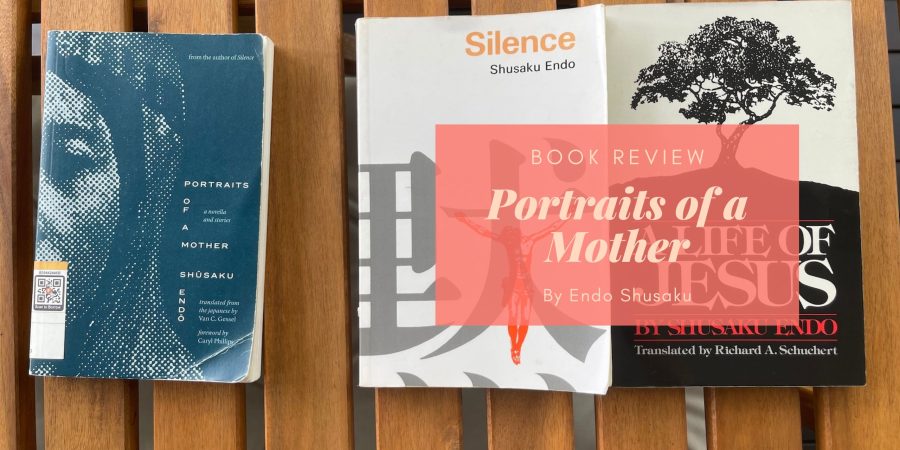
I was looking for a different Endo book in the library when I chanced upon this one and was hooked by the line “a newly discovered novella”. Apparently in 2020, a curator at the Endo Shusaku museum in Nagasaki discovered the novella that is translated and collected with five short stories (three of which are also translated into English for the first time) into this book, titled: Portraits of a Mother.
Despite the title, this book is notable to me, for the presence of the father. Looking back, I’ve always associated Endo with advocating for the maternal love of God to be highlighted to the Japanese. This is partly with the way I was introduced to Endo, where I learnt that he came to the faith via his mother, who was a devout Catholic, but also through passages such as these:
“But the image of God that John embraced was a father-image — the image of wrath, and judgement, and punishment. […] His [Jesus’] heart was like a maternal womb to engender an image of God which more closely resembles a gentle mother, the image of God which he would disclose to the people on a mountain by the Lake of Galilee at a later time.”
This quote comes from the same chapter of Endo’s book: A Life of Jesus, which was his attempt to explain Christianity to the Japanese. A Life of Jesus was a good book for me to revisit alongside Portraits of a Mother, not just because it helped me to remember how Endo viewed the love of God, but also because one of the chapters shares a similar (English) title as one of the short stories.
And while the passage quoted above seems to divide God into a stern father figure and a warm, gentle maternal figure, the truth of Endo’s feelings towards his parents are a lot more complicated, as these stories show. As Caryl Phillips points out in the introduction to this book, Endo draws on his own life to write his stories, and with his matter of fact story-telling style, it can be hard to tell where reality ends and fiction begins. In fact, it feels like the four of the five short stories could be nonfiction essays where Endo is working out his emotions towards his parents. As Endo writes in Shadows:
“And as I ponder how you looked as you stood with your back to me, that image is superimposed upon several other shadows that have crossed the river of my life. […] I can’t help but feel that all of these images have formed into a chain inside me, binding themselves together into blood relations, and are trying to communicate something to me.”
It is while plumbing the depths of his experiences that we see how complicated Endo’s relationship to love is. It is true that he loves his mother, even to the point of resenting anyone else’s criticism of her, but it is a love mingled with resentfulness – not just of her making him into a Catholic, but also of her singlemindedness that drove her forward into loneliness. More than once, the mother figure in the short stories is described as devoted to the practice of the violin that “because her mind was completely focused on her five fingers until she could locate the one sound she was pursuing, she couldn’t hear anything resembling the voice of a child.” (Confronting the Shadows). These are not gentle maternal figures like what I quoted from A Life of Jesus, these mothers are forces of nature, impacting the lives of others as they charge forward. By contrast, the father figures in his stories are portrayed as those who prefer to avoid extremes, who say things like “The greatest happiness comes from being ordinary. The greatest happiness comes when nothing at all happens.” (A Six Day Trip). The sternest that a father figure gets is in the short story Shadows, where the narrator writes a letter to a priest, previously full of life and force, but is disgraced when caught in a relationship with a Japanese woman. But like with what Endo explores in his novel Silence, those who are too strong have hidden weaknesses.
“If there are the strong and the weak among human beings, in those days you were truly one of the strong. And I was a spineless weakling. You had confidence in your way of life, in your faith, in your body, and you performed your missionary work in Japan with firm conviction. In contrast, not once in my life have I been able to feel confidence and conviction about every facet of my life. As I say this, I imagine that in your current state you will understand everything. But in the past, you would have shaken your head, and in a loud voice you would have cried that man exists so that he can strive to reach ever greater heights throughout his life. But weren’t you forced to learn, some fifteen years later, that unexpected perils and danger spots like thin ice lurk within such strength, and that amidst such perils come the beginnings of true religion?” (Shadows)
Does this not echo the path that Roderigues took in Silence, from despising Kichijiro as one of the weak who apostasized to understanding his feelings?
““Father, I betrayed you. I trampled on the picture of Christ,” said Kichijiro with tears. “In this world are the strong and the weak. The strong never yield to torture, and they go to Paradise; but what about those, like myself, who are born weak, those who, when tortured and ordered to trample on the sacred image…”
“I, too, stood on the sacred image. For a moment this foot was on his face. It was on the face of the man who had been ever in my thoughts, on the face that was before me on the mountains, in my wanderings, in prison, on the best and most beautiful face that any man can ever know, on the face of him whom I have always longed to love. Even now that face is looking at me with eyes of pity from the plaque rubbed flat by many feet. ‘Trample!’, said those compassionate eyes. ‘Trample! Your foot suffers in pain; it must suffer like all the feet that have stepped on this plaque. But that pain alone is enough. I understand you pain and your suffering. It is for that reason that I am here.”” (Silence)
Strength and weakness, mother and father, love and hate. To Endo, all these seem intertwined. Through the short stories and the novella collected here, he explores his complicated feelings towards them all and then comes short of a resolution. Confronting the Shadows, the novella that ends the collecting, shows the father explicitly in competition with the mother, and the narrator (perhaps Endo’s stand-in), as the child caught between the two, even after he has become an adult and started his family. This is, perhaps, the reason why Endo could never let go of God, though he tried for years to find something else (according to his biography in Yancey’s Soul Survivor). In the end, it was Jesus who he found so compelling, especially in how he suffered with and loved those that the world calls weak, and I think that it’s this attraction to such a perfect love, and the gap between that and his own experience, which is the undercurrent behind this collection of short stories about the imperfect but compelling loves between parents and child.
As someone who has read Endo for years, this collection was a beautiful surprise that helped me to think about his other works, and I really enjoyed bringing out A Life of Jesus and Silence as I worked out my thoughts about Portraits of a Mother.
What a thought provoking read!
Thanks, I really loved it! I guess I was in the right place to read this too