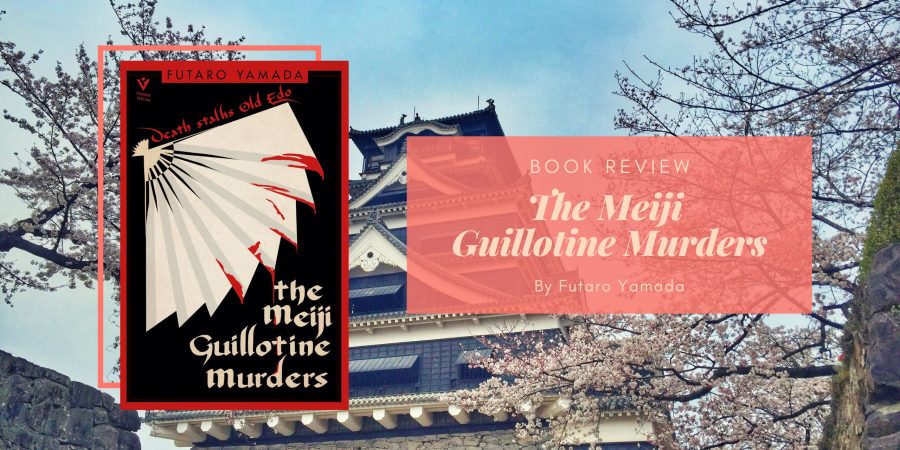
I borrowed this book quite impulsively from the library, but then put it to one side for a bit while I reread Endo’s Silence and Foreign Studies. After that, I picked this up thinking that I should read the book before the loan expires and was shocked to find that the first chapter featured discussion about the importation of a western device – the guillotine – into Japan. It felt like this book was going to be a historical murder mystery that looked at the chaos in the Meiji era and perhaps even the clash between new ideas from the West and traditional ones from Japan, but ultimately, I was left conflicted by this book.
The Meiji Guillotine Murders is a collection of 7 connected murder mysteries, with subjects ranging from the living ghost of a man who is supposed to be in America to a mysterious hanging to the case of a head that might have been swapped with a body. Each case was fascinating in its own right, and as I understand it, is built on a lot of historical detail. So in a way, this is a bit like A Disappearance in Fiji, in that both books will introduce you to another time and culture, but I think The Meiji Guillotine Murders has even more historical context inside.
However, as with A Disappearance in Fiji, the mystery part of this story was the part that disappointed me. I’ll be blunt, so if you don’t like spoilers and intend to read the book, you should close this page now.
I wasn’t a fan of how, for 6 of the mysteries, the case was “solved” through Esmeralda, a French woman who was trained as a Miko and who channeled the voice of the dead. It made interesting cases far too easy because it was solved with a “confession” from the dead man. At the end, it is revealed that all these cases are tied up into one larger case, and the supernatural aspect is not as strong as it first appears, but because we have already spent most of the book having the cases solved for us, the last reveal went from a surprising “aha” moment where unexpected pieces fit together into another over-explanation of a mystery. Perhaps if the POV characters were fewer or if there was more detective work and deduction involved, this would have been more convincing, but as it is, the mystery aspect of this book felt like it was taken away.
That said, I still enjoyed the book for the most part because this is a fascinating period of history in Japan and the author does spent a lot of time on the political intrigues that was taking place. If you ignore the murder mystery part and take this purely as historical fiction, then there is a lot to enjoy about this book. And this is why I am conflicted – As a fan of the mystery genre, I am disappointed because while I can see how the structure of the book was set up, too much of the smaller “mysteries” were unsatisfying for me to be happy with the final reveal. But as a fan of historical fiction, this one really scratched my itch and I could see even myself enjoying this as a Jdrama. So take this review as you will and if you read it, perhaps calibrate your expectations so you enjoy this book for what it is.
It’s always so disappointing in a mystery book when the resolution isn’t done well, it’s the whole point!!
Right?? It’s a pity because the set up was good!