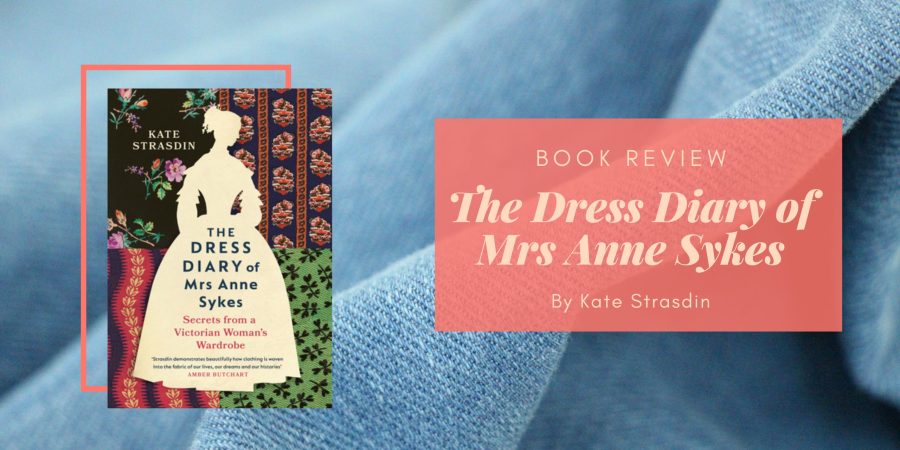
I can’t remember how I found this book but I must have had it on hold for close to a year before the library decided to get a new copy. I’m glad to say that I found this book as interesting as I expected, and with a pleasant surprise!
The Dress Diary of Mrs Anne Sykes uses an actual diary (or rather, collection of fabric swatches) to unpack the life of an upper-class Victorian woman, the titular Mrs Anne Sykes. Because this notebook only has fabrics and some brief notes on it (for example, what it was used for, who it was for, and the year), there is a lot we don’t know and cannot know, such as what Anne Sykes thought or felt. But Kate Strasdin has managed to use what is in the diary to give us a view of what it was like to be a woman in Victorian times, so while we are unable to get personal details (though Strasdin does frequently wonder about it), we can get a good idea of what life was like for Anne Sykes.
For me, the biggest surprise was that Anne Sykes and her husband lived in Singapore for an extended period of time! As such, I actually learnt a lot about the lives of the wives of the British colonialists, something that I had never considered before. Strasdin managed to find letters from another woman who knew Anne Sykes and appeared in her book, and that managed to paint a fuller picture of life in colonial Singapore.
Some general things that I learnt/quotes that I liked while reading the book included:
- “Even if we have no interest in fashion, we still choose garments that are indicative in some way of the culture landscape that shapes each one of us.”
- At the time Anne Sykes lived, ready-to-wear clothes was not the default option, hence the women who bought the dresses also had to be familiar with the language of dress and cloth (this is also why Anne Sykes could collect so many fabric scraps, they were leftovers from bolts of cloth bought for making clothes).
- The utterly horrible conditions that seamstresses worked – and I don’t things things have improved that much since then given what we know about fast fashion!
- Because clothes were not as readily available, mending and caring for clothes was a key skill. And that had one consequence that we may not think of today, because as the book puts it: “Impossibly time-consuming though most of the nineteenth-century practices were, when it came to the art of laundering clothes, the imperative that lay behind it was one of value: to value the textiles, the processes and time required to care for those garments with which we choose to clothe our bodies.“
- Though colonial Singapore was a trading hub and had luxurious clothes passing through her ports, “cloth was scarce for American and European women living there. They relied on the infrequent gifts from home, morsels of valuable fabric and trimmings that they could adapt for their wardrobe.“
- The intricacies of mourning clothes, while an expense and also a social obligation that was impossible to ignore, was also a way to silently communicate one’s circumstances in an era where verbal confessions of emotion were not so easily or freely shared.
The only thing I wish the book had more of was more photographs of the dress diary. There are a few photos in the ebook (which you have to see on a phone or, ideally, a tablet to properly take in, since I was unable to enlarge the photo) but I would have loved to have more images to pore over. The ebook had a QR code that hinted at more information, but the QR code led to a dead link when I scanned it, which is a pity.
Overall, though, I really enjoyed The Dress Diary of Mrs Anne Sykes for its look into a time period so different, but also sometimes surprisingly similar to ours. I was especially interested in the chapters about Singapore and thought it provided a nice counterpoint to the history lessons in school.
Read This With
- The Formidable Miss Cassidy by Meihan Boey – This fun historical fantasy is set in the late 19th Century Singapore, so around the same time as this book. If you like the idea of another book set in Singapore, and especially if you like folklore, this is the book for you (link to my review).
- The Notebook by Roland Allen – If you were thinking that it’s unusual to collect scraps of fabric… well Rolan Allen has a whole history of how we have been using the notebook and it might give you more ideas for what to do with yours (link to my review).
- Their Darkest Materials by Penelope Hemingway – This is a book that I wanted to reread as I was reading this. If you’re shocked by the poor treatment of seamstresses and the rather horrible working conditions in the cotton mills as well, this book will probably continue to shock you with the dark history of textiles. But, I do think it’s important for us to be aware of the darker history so we can be more careful and appreciative of the clothes we do have (link to my review).
Featured Image: Photo from Canva
Oh my gosh this sounds so interesting, I love learning about garment history!
Yesss I would totally want to add this to my mini collection on textile/dress history!