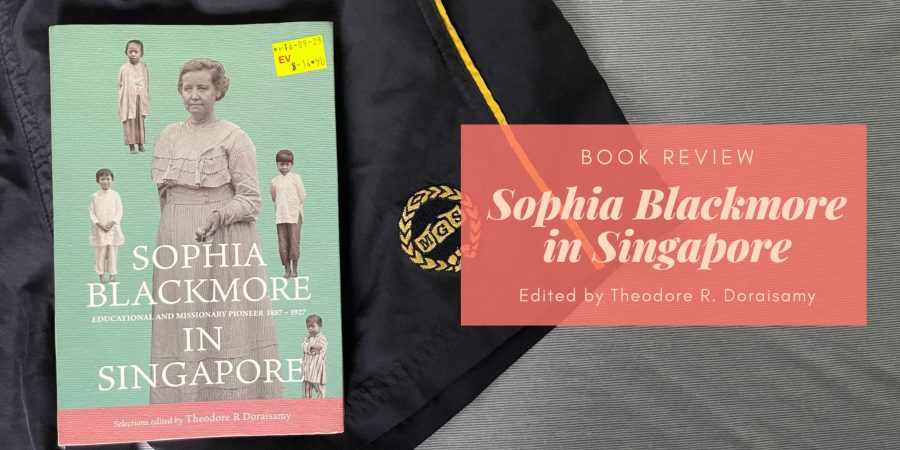
This is one of those books that’s not of interest to the general public (I think) and also not easy to find (again, I think) but which I want to write a review about mostly so people know that it exists. Sophia Blackmore (18 October 1857 – 3 July 1945) founded both my alma mater, where I spent 10 years studying, as well as my mother’s alma mater. But despite the fact that I know who she is, I don’t know much about what else she did, and I definitely did not know that this book existed until I chanced upon it at a used book’s fair.
Sophia Blackmore in Singapore takes excerpts from Blackmore’s letters, articles in various Methodist publications in Singapore and from their archives to trace Sophia Blackmore’s life in Singapore, from her posting to Singapore to the legacy she left behind. I found it quite interesting to learn that Singapore was not her initial destination – she initially wanted to be a missionary to China, found herself in India, and ended up in Singapore after Dr Oldham urgently appealed for women to come and work here. From this providential posting, Sophia Blackmore started two schools and also ran Nind Home, a residence for orphans and poorer girls.
It’s clear that Blackmore put in a lot of work, visiting and building up relationships with the local community, and in fact a lot of the work could not be done without partnership from the local community. There was resistance to educating girls, including a fear that “if her daughter studied from the same book as her son, the girl would get all the learning out of it; there would be none for the boy, and he would be bodoh (stupid).” Clearly, there must have been buy-in from the local community to send their girls to school despite the social pressures, and there are stories of Chinese congregants donating money to help in times of need, and even starting schools! The book recounts the story of Tan Keong Keng’s oldest daughter, known as B’sar, who started a girl’s school in her father’s home in Malacca and with the help of Emma Shellabar, who went around visiting the Peranakan chinese, the school expanded so much that “Mr and Mrs Tang Keong Keng and Miss Tan Siok Kim became co-founders of the Methodist Girl’s School in Malacca.”
When I was younger, I mainly thought of Sophia Blackmore as the woman who started my school and was largely unaware of how connected she was to the rest of the Methodist society in Singapore. I didn’t realise, for example, that she preached at Telok Ayer with Benjamin West, who ended up founding my Church (the first Chinese Methodist Church in Singapore).
Overall, this book was a lovely surprise. I learnt a lot more about Sophia Blackmore and about the history of Methodism in Singapore more generally, and I really appreciated the many photos that were included in the book. The edition I read was the revised edition published in 2024 by Covenant Community Methodist Church, and I’m glad they did because I probably would not have learnt so much otherwise.
I think you’re right about this being quite niche but I’m glad you got a lot out of it
Thank you! I think it’s the nice thing about books when they don’t have to chase bestseller status – they can be written for the niches